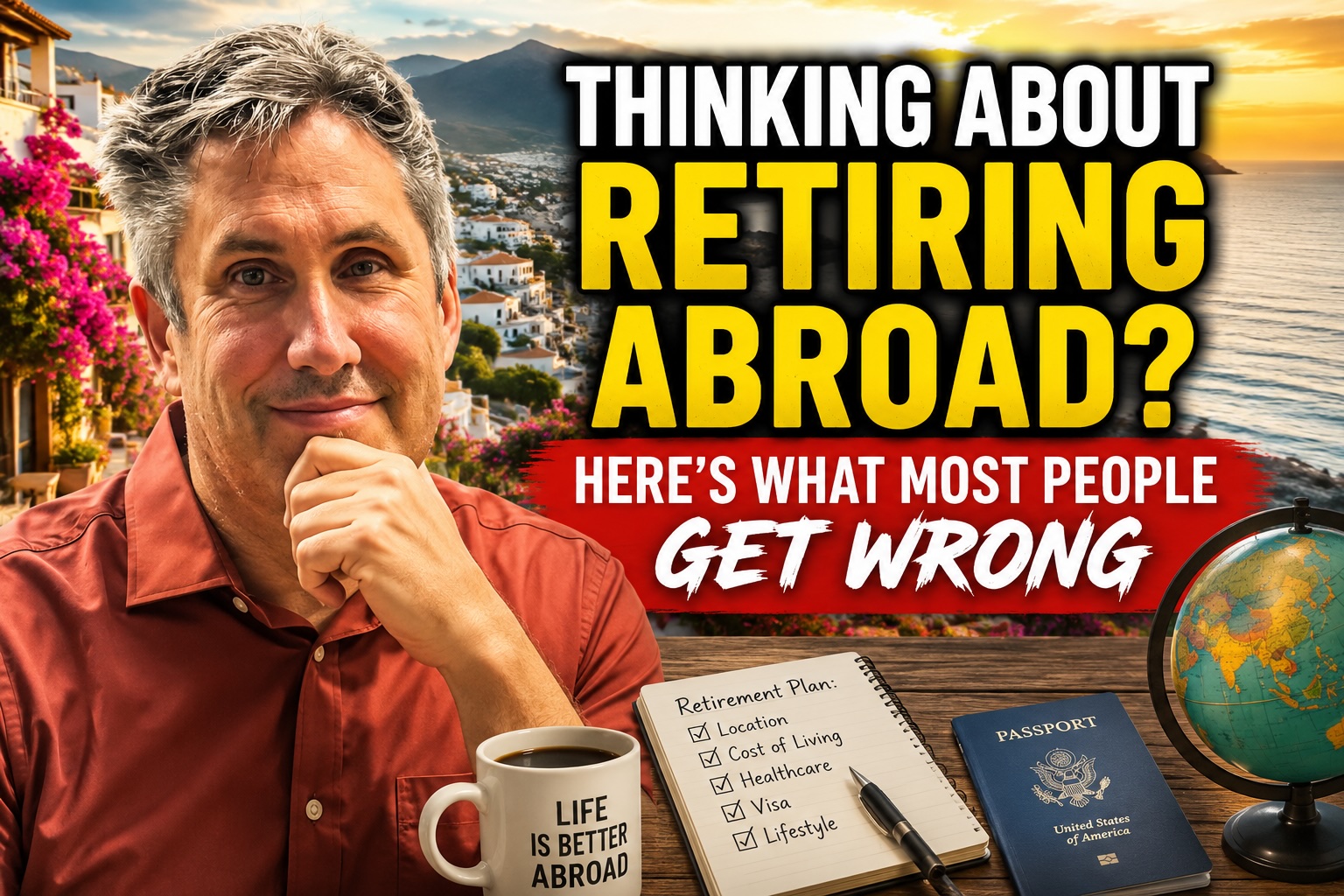
For many Americans, retirement isn’t just about slowing down—it’s about finally living the life they’ve always imagined. Maybe you’ve pictured yourself enjoying fresh seafood at a café overlooking the ocean, strolling through a charming European village, or waking up to tropical sunshine without worrying about sky-high living costs. I’ve been working on helping Americans learn about options for retiring overseas for a little over a year. As of right now, there are over 50 videos on retiring abroad on my YouTube channel. However, there are some important considerations people need to make before taking the leap and moving overseas. I’ve created this post and an accompanying video for people like you who are curious. Take a look at the video below:
It’s no surprise that more Americans are exploring the idea of retiring abroad. Lower costs, excellent healthcare, beautiful scenery, and a slower pace of life make overseas retirement incredibly appealing. But while countless YouTube videos and social media posts make the transition look effortless, the reality is often more nuanced.
The biggest mistakes people make usually aren’t financial—they’re based on unrealistic expectations.
After researching retirement destinations around the world and speaking with countless expats, I’ve noticed the same misconceptions come up again and again. Fortunately, they’re all avoidable with the right planning.
If you’re considering retiring overseas, here are the biggest things most people get wrong—and what you should do instead.
1. Believing It’s Only About Saving Money
One of the biggest myths surrounding retirement abroad is that it’s simply a way to stretch your Social Security check. If you’re like me, you’re now living on a fixed income. It may be Social Security, your 401(k), or a pension. You will notice that costs don’t ever go down but rather increase. Retiring overseas sounds like an attractive options for getting more enjoyment and life out of your retirement income.
Yes, many countries offer a significantly lower cost of living than the United States. Housing, healthcare, groceries, transportation, and dining out can often cost far less than what many retirees currently pay at home.
But focusing solely on affordability can lead you to choose the wrong destination.
Imagine finding a country where rent is incredibly cheap—but the climate doesn’t suit you, healthcare isn’t convenient, or you’re hundreds of miles away from the nearest international airport. Saving money won’t matter much if you’re unhappy living there. For example, we may have a medical issue that requires regular advanced healthcare. I, for example, would never want to move to a remote island without a decently equipped hospital less than an hour away. Also, I am not a fan of snow. I have lived my entire life in Southern California, where the winter lows are in the 50s. I can’t imagine living in Canada, Northern Euriope, or Central Europe, where snow falls half the year.
The happiest expats tend to prioritize several factors:
- Quality healthcare
- Personal safety
- Climate
- Walkability
- Reliable infrastructure
- Friendly communities
- Access to hobbies and recreation
- Ease of traveling back to the United States
Money certainly matters—but lifestyle matters even more.
The goal isn’t simply to retire somewhere inexpensive.
It’s to retire somewhere you’ll genuinely enjoy calling home.
2. Assuming Every Country Is Ready to Welcome American Retirees
Many first-time retirees believe they can simply pack their bags and move overseas.
Unfortunately, it rarely works that way.
Every country has its own immigration rules, residency requirements, and retirement visa options.
Some countries actively encourage foreign retirees by offering dedicated retirement visas with straightforward income requirements. Others have far more complicated residency processes that may involve minimum investments, proof of savings, health insurance, criminal background checks, or regular visa renewals.
These rules also change over time.
That’s why one of the smartest things you can do early in your planning is research the visa requirements for every country you’re considering.
Don’t fall in love with a destination before confirming that you’re actually eligible to live there long-term.
Doing your homework now can save months of frustration later. I HIGHLY recommend reviewing my video on avoiding retirement mistakes:
3. Expecting Everything to Work Like It Does in America
One of the fastest ways to become frustrated overseas is expecting daily life to function exactly as it does in the United States.
It won’t.
And that’s okay.
In many countries, banks operate shorter hours. Government paperwork may take longer. Businesses may close in the afternoon. Restaurants might not rush customers through meals. When I lived as a student in Germany during university, I found out very quickly that EVERYTHING is closed on Sunday. Growing up in Southern California, I had access to shopping 24/7. I needed to quickly adjust to not being able to pick up milk or other groceries on Sunday, if I was out.
Instead of viewing these differences as inconveniences, successful expats learn to appreciate them as part of a different way of life. Using the example above, I simply made sure I had sufficient supplies by Saturday
Culture isn’t something to overcome.
It’s something to experience.
The retirees who thrive overseas usually share one characteristic:
They’re adaptable.
They understand that living abroad isn’t about recreating America somewhere else.
It’s about embracing a new culture while keeping the parts of home that matter most.
4. Waiting Too Long to Learn About Healthcare
Healthcare consistently ranks among the biggest concerns for Americans considering retirement overseas.
Ironically, it’s also one of the biggest pleasant surprises.
Many countries offer modern hospitals, highly trained physicians, and private healthcare at prices that often shock Americans—in a good way.
That doesn’t mean every healthcare system is identical.
Some countries offer public healthcare programs for residents.
Others rely primarily on affordable private healthcare.
Some retirees choose international health insurance, while others pay directly out of pocket for routine care because costs remain surprisingly reasonable.
Before moving abroad, research:
- Local hospitals
- Prescription availability
- Specialist access
- Emergency care
- Health insurance options
- Whether pre-existing conditions affect coverage
Healthcare shouldn’t be an afterthought.
It should be one of the first items on your retirement planning checklist.
5. Underestimating the Emotional Side of Moving Overseas
Moving abroad isn’t just a financial decision.
It’s an emotional one.
Many retirees spend months comparing housing costs and tax rates while giving very little thought to what everyday life will actually feel like.
Eventually, almost everyone experiences moments of homesickness.
You may miss family gatherings.
Favorite restaurants.
Sporting events.
Even simple conversations with neighbors.
These feelings are perfectly normal.
The good news is that most successful expats actively work to build new routines.
They join local clubs.
Volunteer.
Attend language classes.
Meet both locals and fellow expatriates.
Schedule regular video calls with family.
Before long, what once felt unfamiliar often begins to feel like home.
Community doesn’t happen automatically.
You have to create it.
6. Thinking One Vacation Tells You Everything
Vacation life and everyday life are two completely different experiences.
When you’re on vacation, everything feels exciting.
You’re exploring.
Eating at restaurants.
Relaxing.
Taking photos.
Real life includes grocery shopping.
Paying utility bills.
Finding a dentist.
Visiting government offices.
Waiting for internet installations.
Learning public transportation.
Understanding neighborhood noise.
That’s why I always recommend what I call a “test drive.”
Instead of buying property immediately, spend one to three months living like a resident.
Rent an apartment.
Cook meals.
Shop at local markets.
Use public transportation.
Experience both weekdays and weekends.
This approach often confirms that you’ve found the perfect place—or reveals challenges you never noticed during a one-week vacation.
Either outcome is valuable.
7. Neglecting Long-Term Financial Planning
Moving overseas doesn’t eliminate the need for smart financial planning.
In fact, it makes planning even more important.
Before relocating, think beyond your monthly budget.
Consider:
- Taxes
- Currency exchange rates
- Banking access
- Emergency savings
- Inflation
- Estate planning
- Receiving Social Security overseas
- Investment accounts
Exchange rates fluctuate.
Costs change.
Unexpected expenses happen everywhere.
Building a comfortable financial cushion gives you flexibility if your plans need to change.
Financial preparation isn’t about expecting disaster.
It’s about creating peace of mind.
What Successful American Expats Do Differently
After observing retirees around the world, I’ve noticed something interesting.
The happiest expats aren’t necessarily the wealthiest.
They’re simply the best prepared.
They tend to:
- Research several countries instead of focusing on just one.
- Visit multiple times before making a decision.
- Rent before buying property.
- Learn at least basic phrases in the local language.
- Build friendships with both locals and other expats.
- Stay flexible when plans change.
- Keep realistic expectations.
- Maintain emergency savings.
- Continue learning long after they arrive.
Notice that none of these habits require extraordinary wealth.
They simply require patience, curiosity, and thoughtful planning.
There Is No “Perfect” Country
One of the biggest misconceptions I hear is people asking:
“What is the best country to retire in?”
The truth is, there isn’t one.
The best destination depends entirely on your priorities.
If healthcare tops your list, your answer may differ from someone focused on beaches.
If staying close to grandchildren matters most, you’ll likely choose somewhere different than someone seeking adventure.
When evaluating countries, ask yourself:
- What climate makes me happiest?
- How important is affordable healthcare?
- How often do I want to visit family?
- Do I want to learn another language?
- What lifestyle do I actually want every day?
The right destination isn’t the one someone else recommends.
It’s the one that fits the life you want to build.
Final Thoughts
Retiring abroad can be one of the most rewarding decisions you’ll ever make—but only if you approach it with realistic expectations.
Don’t chase low prices alone.
Research visa requirements before making plans.
Understand the local healthcare system.
Prepare financially for the long term.
Recognize that every destination comes with trade-offs.
Most importantly, give yourself permission to move slowly.
You don’t have to make every decision today.
Visit different countries.
Ask questions.
Talk to people who have already made the move.
Test-drive your future before committing to it.
The dream of retiring overseas isn’t about escaping your current life. It’s about intentionally designing the next chapter of it.
With thoughtful planning, an open mind, and realistic expectations, you’ll be in a much stronger position than the people who rush into the process based on assumptions alone.
And that makes all the difference.
What’s Your Biggest Question About Retiring Abroad?
I’d love to hear from you.
Is there a particular country you’re considering? Are you wondering about healthcare, visas, taxes, or cost of living?
Leave a comment below and join the conversation.
If you’d like even more practical advice, destination guides, and honest insights about life overseas, be sure to visit my Retire Without Borders YouTube channel. My goal is to help Americans make informed decisions about retirement abroad—so when you finally make the move, you’ll do it with confidence.