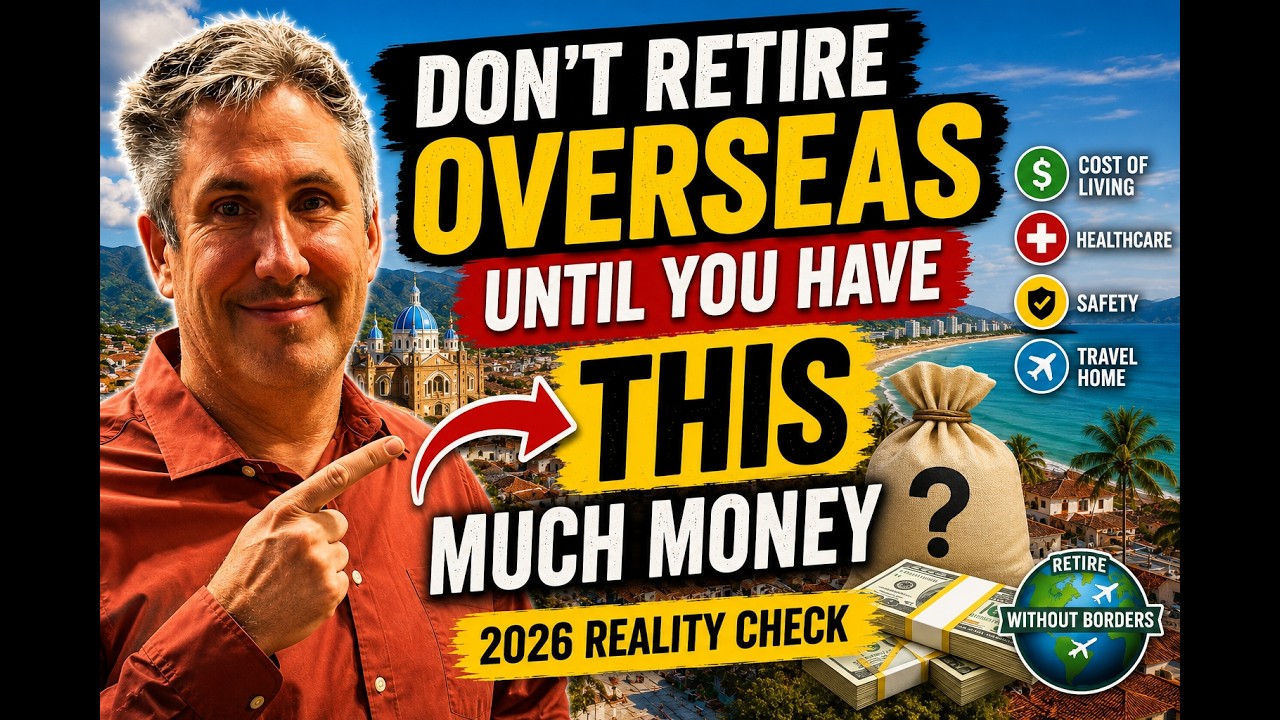
How Much Money Do You Need to Retire Overseas in 2026?
You’ve probably seen the headlines.
“Retire overseas on $1,500 a month!”
Or maybe it’s $1,200. Sometimes even $1,000.
And depending on where you go, those numbers aren’t necessarily wrong. There are still places in Mexico, Latin America, and Southeast Asia where a retiree can live on considerably less than they would spend in the United States.
But there’s an important difference between being able to live somewhere for $1,500 a month and being financially prepared to retire there.
That distinction is what often gets lost.
When people calculate the cost of retiring overseas, they usually start with the obvious expenses: rent, groceries, utilities, and maybe transportation. Add those together, compare the total with Social Security, and suddenly retiring abroad looks surprisingly affordable.
But what about healthcare?
What about flying home to see your children and grandchildren?
What about taxes, insurance, currency fluctuations, visa expenses, or an unexpected emergency?
And perhaps most importantly, what happens if you move overseas and, two or three years later, decide you want—or need—to come back to the United States?
Those expenses are part of retirement too.
I’ve spent a lot of time researching retirement destinations around the world, and one thing has become increasingly clear to me: choosing where to retire based solely on the lowest possible monthly budget is the wrong way to approach the decision.
Yes, cost matters. For many Americans, it’s one of the biggest reasons to consider retirement abroad in the first place.
But the real objective shouldn’t be to find the cheapest place you can possibly live.
The goal isn’t just to retire cheaper. It’s to retire better.
And to do that, you first need a realistic understanding of what your retirement will actually cost.
There Is No Single “Magic Number”
So, how much money do you need to retire overseas?
I wish I could give you one number.
$2,000 a month. Done.
Unfortunately, it doesn’t work that way.
Think about asking someone, “How much does it cost to retire in the United States?”
Where?
Manhattan? Honolulu? Los Angeles?
Or a small town in Arkansas?
Those could produce completely different answers, and retiring overseas works exactly the same way.
Living in a smaller city in Ecuador is very different financially from living in Lisbon. Chiang Mai is different from Phuket. A smaller Mexican city will have a very different budget from a beachfront condo in Puerto Vallarta.
Even two retirees living in the same city can have dramatically different expenses.
One person might rent a modest one-bedroom apartment, shop at local markets, use public transportation, eat primarily local food, and spend $1,800 a month.
Another might want a modern two-bedroom condo, air conditioning, imported American products, frequent restaurant meals, a car, private health insurance, and several trips back to the United States each year.
Their budget might be $3,500 or $4,000 a month—or considerably more.
Neither person is doing retirement wrong.
They’re simply buying different lifestyles.
A Useful Starting Point
For planning purposes, I think it helps to think about overseas retirement in three broad budget ranges.
| Monthly Budget | What It Could Mean |
|---|---|
| $1,500–$2,000 | A lean retirement in certain lower-cost destinations |
| $2,500–$3,500 | A comfortable lifestyle in many affordable countries |
| $4,000+ | A very comfortable lifestyle in many lower-cost destinations, with more room for travel and unexpected expenses |
These aren’t hard rules, and they certainly aren’t guarantees.
A $2,500 monthly budget might provide a very comfortable lifestyle in one country and feel surprisingly tight in another. Housing alone can completely change the calculation.
There’s another issue, too.
Monthly expenses aren’t the same thing as financial security.
Imagine two retirees who each spend $3,000 a month.
The first receives $3,000 every month from Social Security and a pension and also has substantial retirement savings.
The second has $1,800 in Social Security and needs to withdraw the remaining $1,200 from savings every month.
Their lifestyles might look identical, but their long-term financial situations are very different.
That’s why I don’t think the most useful question is:
“What’s the cheapest country where I can retire?”
A better question is:
“What kind of retirement can my income and savings comfortably support—and where can I build that life?”
Once you know that number, you can begin looking for destinations that fit you, rather than trying to squeeze your life into somebody else’s $1,500-a-month retirement budget.
And to figure out that number, there are five major expenses I think every prospective expat retiree needs to consider.
The first—and usually the biggest—is the one everyone expects: your everyday cost of living.
Expense #1: Your Everyday Cost of Living
When most people start researching retirement overseas, this is where they begin—and for good reason.
Your basic cost of living will probably make up the largest portion of your monthly retirement budget. It’s also where moving abroad can potentially create the biggest savings.
Housing, groceries, utilities, transportation, restaurants, and entertainment can cost considerably less in many popular retirement destinations than they do in the United States.
But there’s a catch.
The lifestyle you choose matters just as much as the country you choose.
Housing Will Probably Be Your Biggest Variable
Let’s start with housing.
You might find a perfectly comfortable apartment in a smaller overseas city for $600 or $700 a month. Move into a modern condo in a popular expat neighborhood, however, and that same basic expense could easily double.
Move within walking distance of the beach, and it may go higher still.
This is something I think gets overlooked when people see those incredibly low retirement budgets online. The advertised rent might be real, but that doesn’t necessarily mean it’s for the kind of home—or location—you would actually choose.
Ask yourself what you really want.
Do you need two bedrooms because you expect family to visit? Do you want to be able to walk to restaurants and shops? Is air conditioning essential? Do you want a pool, security, an elevator, or a view? Are you comfortable living in a local neighborhood, or would you prefer an area with a well-established expat community?
Every one of those decisions can change the number.
And there’s nothing wrong with wanting those things.
The purpose of moving overseas isn’t to see how much you can give up. It’s to determine whether your money can buy you a better quality of life.
Living Like a Local vs. Recreating Your American Lifestyle
Food is another great example.
If you shop at local markets, buy locally produced food and eat where locals eat, your food budget may be surprisingly low.
But if you want imported American brands, specialty foods, familiar restaurant chains, and Western products, some of those items can actually cost more than they did back home.
I’ve seen this same pattern in country after country.
The people who tend to get the most financial benefit from living overseas aren’t necessarily the people who deprive themselves. They’re often the people who adapt.
They discover the neighborhood bakery instead of looking for the exact bread they bought in America. They eat at local restaurants. They use public transportation. They shop where their neighbors shop.
That doesn’t mean you have to abandon everything familiar. But if your plan is to recreate your American lifestyle exactly—just in another country—you may not save nearly as much money as you expect.
What Might an Everyday Overseas Budget Look Like?
Let’s use a hypothetical retiree living in a relatively affordable overseas destination.
Their basic monthly expenses might look something like this:
| Expense | Monthly Cost |
|---|---|
| Rent | $900 |
| Groceries & Dining | $500 |
| Utilities & Internet | $200 |
| Transportation | $200 |
| Entertainment & Misc. | $300 |
| Total Basic Living Costs | $2,100 |
That sounds pretty good.
For $2,100 a month, this retiree has housing, food, utilities, transportation, and some money for entertainment.
And compared with the cost of maintaining a similar lifestyle in many parts of the United States, it could represent substantial savings.
But here’s where retirement planning gets interesting.
That $2,100 isn’t necessarily your retirement budget.
It’s your living budget.
There is a difference.
The Expenses That Don’t Show Up in a Typical Monthly Budget
A basic cost-of-living calculation often tells you what an ordinary month might cost.
Retirement planning has to account for the months that aren’t ordinary.
Maybe your visa or residency permit needs to be renewed.
Maybe you need a new laptop.
Maybe the air conditioner breaks and you’re responsible for replacing it.
Maybe you need dental work.
Maybe the dollar suddenly weakens against the local currency.
Maybe you want to fly home for Christmas.
Or maybe your children call and tell you there’s a family emergency and you need to be on an airplane tomorrow.
Those expenses may not appear in the attractive “$2,000-a-month retirement” budget you found online.
But they’re still real.
That’s why I wouldn’t build an overseas retirement plan around the absolute minimum amount you believe you can live on.
If your calculations tell you that you can live comfortably for $2,100 a month, I wouldn’t want $2,100 to be every dollar available to me.
I want margin.
That margin is what allows you to enjoy retirement without constantly worrying about whether an unexpected $500 expense is going to wreck your budget.
Don’t Forget Inflation and Exchange Rates
There’s another variable Americans don’t have to think about as much when retiring domestically: currency.
You may receive Social Security, pension income, or retirement withdrawals in U.S. dollars while paying many of your expenses in pesos, euros, baht, ringgit, or another currency.
If exchange rates move in your favor, that’s great.
If they move against you, the same lifestyle suddenly costs more in dollar terms.
And then there’s ordinary inflation.
The inexpensive destination you discover today won’t necessarily remain that inexpensive for the next 20 years. Popular expat destinations can become especially vulnerable to rising rents as tourism and foreign demand increase.
So when you’re comparing countries, don’t ask only:
“What would it cost me to live there today?”
Ask:
“Could I still comfortably afford this lifestyle if my expenses were 15 or 20 percent higher?”
That’s a much better stress test.
Start With the Life You Actually Want
Before you decide whether Mexico, Ecuador, Malaysia, Thailand, Portugal—or anywhere else—is affordable, write down what your actual retirement would look like.
Not somebody else’s retirement.
Yours.
What kind of home do you want? How often will you eat out? Will you own a car? Will you travel? Do you want to live near the beach? Will you need room for visiting family? Are you comfortable without certain American conveniences?
Then price that lifestyle.
You may discover that you can live extremely well for far less than you expected.
Or you may discover that the $1,500-a-month retirement you’ve been promised isn’t realistic for the lifestyle you actually want.
Either answer is useful.
Because the objective isn’t to find the lowest number possible.
It’s to find a number you can sustain—and a lifestyle you’ll actually enjoy living.
And there’s one expense where I especially don’t recommend building your plans around the cheapest possible option.
Healthcare.
Expense #2: Healthcare — The Expense You Can’t Afford to Ignore
For many Americans considering retirement overseas, healthcare is one of the biggest questions.
And understandably so.
One of the attractions of retiring abroad is that healthcare can be significantly less expensive than it is in the United States. In many popular retirement destinations, you’ll find modern private hospitals, well-trained doctors, and medical services that cost a fraction of what Americans are accustomed to paying.
But there’s an important distinction:
Affordable healthcare doesn’t mean free healthcare.
And as we get older, this is one area where I don’t think it makes sense to build a retirement plan around the best-case scenario.
Medicare Usually Doesn’t Follow You Overseas
This catches some prospective retirees by surprise.
You’ve paid into Medicare for years, you finally reach retirement age, and then you discover that Original Medicare generally doesn’t cover healthcare you receive outside the United States, except in a few limited circumstances.
That doesn’t mean you should necessarily give up Medicare if you move abroad. In fact, there can be good reasons to maintain some Medicare coverage, particularly if you expect to return to the United States periodically or might move back someday.
But it does mean you’ll need another strategy for the healthcare you receive while living overseas.
Depending on the country, that might include private insurance, international health insurance, participation in a local healthcare system, paying cash—or some combination of these.
Healthcare Works Differently From Country to Country
This is another reason I don’t like broad claims such as “healthcare overseas is cheap.”
Which country?
The healthcare system in Mexico is different from the one in Portugal. Thailand is different from Malaysia. Ecuador is different from Spain.
Even within the same country, your experience may vary depending on whether you live in a major city or a small rural community.
In many popular retirement destinations, expats choose private healthcare because it can provide faster appointments, English-speaking doctors, more comfortable facilities, and access to larger private hospitals.
In other places, legal residents may eventually qualify for some form of public healthcare.
And some retirees simply pay cash for routine medical care because doctor’s visits, tests, and common procedures can be relatively affordable.
The right approach depends on the country—and on you.
Health Insurance Can Get More Expensive as You Age
Here’s another part of the calculation that deserves more attention.
You may move overseas at 62 or 65 and find private health insurance surprisingly affordable.
But what will it cost when you’re 75?
Or 80?
Some insurance policies become considerably more expensive as you age. Others may have age restrictions, exclusions for pre-existing conditions, deductibles, coverage limits, or restrictions on where you can receive treatment.
That’s why I wouldn’t simply look up today’s premium and plug that number into a 20-year retirement plan.
Ask what happens later.
If you’re comparing international insurance policies, look closely at:
- Age-related premium increases
- Pre-existing condition exclusions
- Deductibles and copays
- Annual and lifetime coverage limits
- Prescription coverage
- Emergency hospitalization
- Geographic coverage
- Medical evacuation
- Maximum enrollment or renewal ages
The cheapest policy today isn’t necessarily the best policy for retirement.
What About Paying Cash?
In some countries, paying out of pocket for routine healthcare can make a lot of sense.
A doctor’s appointment, dental cleaning, blood test, or prescription may cost considerably less than you’re accustomed to paying in the United States.
That can be one of the pleasant surprises of living abroad.
But there’s a big difference between paying cash for a routine doctor’s appointment and paying cash for cancer treatment, heart surgery, a serious accident, or an extended hospital stay.
That’s where I think retirees need to be careful.
A few inexpensive doctor’s visits can create the impression that insurance isn’t necessary. The real purpose of insurance, however, isn’t necessarily to pay for the $40 appointment.
It’s to protect you from the $40,000 emergency.
Location Matters Almost as Much as Cost
There’s another healthcare question I think is even more important than price:
Where is the nearest hospital you’d actually want treating you during a serious medical emergency?
That beautiful little beach town may be perfect when you’re 65 and healthy.
But what happens at 78?
If the nearest major hospital is three hours away, that becomes part of the retirement equation.
When researching a destination, I would look at more than whether the country has “good healthcare.” I’d want to know where the major hospitals are, what specialties are available locally, whether English-speaking physicians are accessible, and what happens if I need care that isn’t available in my community.
This is one reason larger cities—or smaller communities located reasonably close to them—can become increasingly attractive as retirees age.
Build Healthcare Into the Budget From Day One
Let’s return to our hypothetical retiree from the previous section.
We estimated basic living expenses at about $2,100 per month.
Suppose that retiree then needs another $200, $300, $500, or more each month for health insurance, medications, routine care, and other medical expenses.
Suddenly, the real monthly requirement isn’t $2,100 anymore.
And that’s exactly the point.
When you see someone say:
“You can retire in this country for $1,800 a month!”
Find out what’s included.
Does that number include comprehensive health insurance?
Prescription medications?
Dental care?
Emergency medical expenses?
If it doesn’t, you’re not looking at a complete retirement budget.
Don’t Just Ask, “Is Healthcare Cheap?”
Instead, I would ask four questions:
Is the healthcare good?
Can I access it where I want to live?
Can I afford it as I get older?
What happens if something serious goes wrong?
If you can answer those questions confidently, you’re getting much closer to understanding whether a country is genuinely suitable for retirement.
Because saving $700 a month on rent doesn’t mean much if you’re constantly worried about getting the medical care you need.
And healthcare isn’t the only expense that tends to disappear from those attractive overseas retirement budgets.
There’s another one that can become surprisingly expensive—especially when your family is still back in the United States.
Getting home.
Expense #3: Going Home — The Cost Many Retirees Underestimate
When we imagine retiring overseas, it’s easy to focus on the life we’re moving toward.
The beach. The warmer weather. The walkable neighborhood. The lower cost of living. Maybe a morning coffee at a café where nobody seems particularly interested in rushing you out the door.
But there’s another side to living abroad that deserves a place in your retirement budget.
You’re still going to want to go home.
For most American retirees, moving overseas doesn’t mean leaving family and friends behind permanently. Children, grandchildren, siblings, longtime friends, holidays, weddings, graduations, and family traditions are still going to matter.
And occasionally, you’ll need to return home when you weren’t planning to.
That’s why airfare shouldn’t be treated as vacation spending.
For many overseas retirees, travel back to the United States is a recurring retirement expense.
One Trip a Year May Sound Fine—Until You Actually Move
Before moving abroad, it’s easy to imagine returning to the United States once a year.
Maybe you’ll come back for Christmas. Or spend a few weeks visiting the family during the summer.
But life rarely follows such a neat schedule.
A new grandchild arrives.
Your son or daughter gets married.
There’s a milestone birthday you don’t want to miss.
A close friend becomes seriously ill.
A family member needs your help.
Suddenly, that one planned annual trip becomes two or three.
For a single retiree, that’s one thing. For a retired couple buying two airline tickets each time, the expense can add up quickly.
And the farther you retire from the United States, the more significant this can become.
Geography Has a Price
This is one reason I think Americans should consider distance from home when comparing retirement destinations.
Mexico, Costa Rica, Panama, and parts of the Caribbean can offer relatively convenient access to the United States. Depending on where you’re traveling, you may have nonstop flights and be home within several hours.
Move to Southeast Asia, and the calculation changes considerably.
Malaysia or Thailand may offer tremendous value once you’re there, but returning to the United States can mean a much longer and potentially more expensive journey.
Europe falls somewhere in between, depending on the destination and the U.S. city you’re trying to reach.
That doesn’t make one region better than another.
It simply means that a lower cost of living thousands of miles away may come with a higher cost of staying connected to home.
That’s part of the equation.
Don’t Budget Using the Cheapest Airfare You Can Find
There’s another mistake I see when people estimate this expense.
They search for airfare six months in advance, find a terrific fare, and use that as their annual travel budget.
But what happens when you need to travel next week?
Emergency airfare can look very different from the bargain fare you found months earlier.
And as we get older, our tolerance for complicated travel may change as well.
At 60, you might happily take a cheaper itinerary involving two connections and a 26-hour journey.
At 78, you might decide that the nonstop flight—or even a more comfortable seat—is worth paying considerably more for.
That’s another reason retirement projections shouldn’t assume that your travel habits at 65 will necessarily be identical at 80.
Create a Separate “Going Home” Budget
Rather than treating trips to America as unexpected expenses, I think it makes more sense to build them into your annual retirement plan from the beginning.
Suppose a retired couple estimates that two trips back to the United States will cost them $4,000 per year between airfare, baggage, ground transportation, and other travel expenses.
Instead of thinking:
“We’ll worry about that when we buy the tickets.”
Divide it by 12.
That $4,000 becomes approximately $333 per month that needs to be accounted for in the real retirement budget.
You don’t necessarily spend $333 every month. You simply set it aside so the money is there when you need it.
And suddenly our hypothetical $2,100-a-month overseas lifestyle doesn’t look like a $2,100 retirement anymore.
That’s the recurring theme here.
The number that tells you what it costs to live somewhere isn’t necessarily the number that tells you what it costs to retire there.
Consider What Happens When Family Comes to You
Of course, you won’t always be the one getting on the airplane.
One of the benefits of living somewhere interesting is that family and friends may be very enthusiastic about visiting you.
That’s wonderful—but it can create expenses too.
Maybe you rent a two-bedroom apartment instead of a one-bedroom so the grandchildren have somewhere to sleep. Maybe you pay for additional meals, transportation, excursions, or a larger rental car while everyone is visiting.
You may decide those expenses are worth every penny.
I probably would.
But they’re still expenses.
This is why I think retirement planning works much better when you stop trying to identify the absolute minimum amount you can survive on and instead ask:
“What will the life I actually want to live cost?”
The Emotional Cost Matters Too
There’s also something here that can’t be captured completely in a spreadsheet.
Distance feels different once you live it.
Spending three months exploring Southeast Asia is very different from realizing that your grandchildren are growing up 8,000 miles away.
Some retirees discover that they don’t mind the distance at all. Technology makes staying connected easier than it has ever been, and they may return home once or twice a year and be perfectly happy.
Others discover that being closer to family matters much more than they expected.
That’s why I would strongly recommend test-driving an overseas destination before making a permanent move whenever possible.
Stay for a month. Better yet, stay for two or three.
Live there rather than vacation there.
Then pay attention not only to how much money you’re spending, but also to how the distance from home actually feels.
You might discover that Thailand is exactly where you want to spend the next 20 years.
Or you might decide that Mexico gives you enough of the lifestyle and cost advantages you’re looking for while keeping you much closer to the people who matter most.
Both are perfectly reasonable conclusions.
Budget for the Trip You Hope You Never Have to Make
Finally, I would keep enough accessible cash for something none of us likes to think about:
an immediate flight home.
If something happens to a parent, child, sibling, or close friend, you don’t want to be searching for the cheapest airfare or worrying about whether buying a last-minute ticket will upset your monthly budget.
You want to be able to book the flight.
That’s part of financial security.
And it brings us to an important principle that runs throughout this entire discussion:
A good retirement budget doesn’t just pay for your normal life. It gives you room when life isn’t normal.
So when you’re calculating how much you need to retire overseas, don’t stop with rent, groceries, utilities, and healthcare.
Put going home in the budget too.
Because retiring overseas may change where you live.
It doesn’t change where the people you love live.
And once you’ve accounted for living expenses, healthcare, and travel, there’s another category that can quietly take a bite out of that seemingly inexpensive overseas retirement:
Taxes, banking, and the financial cost of living in two worlds.
Expense #4: Taxes, Banking, and the Financial Cost of Living Abroad
Here’s an expense that isn’t nearly as exciting to talk about as inexpensive rent or $3 dinners.
Taxes and money management.
When people imagine retiring overseas, they sometimes assume that leaving the United States means leaving the American tax system behind.
Unfortunately, it generally doesn’t work that way.
If you’re a U.S. citizen living abroad, you generally remain subject to U.S. federal income-tax rules and filing requirements. Depending on where you establish residency, you may also have tax obligations in your new country.
That doesn’t necessarily mean you’ll be taxed twice on the same income. Tax treaties, foreign tax credits, and other provisions can sometimes reduce or eliminate double taxation.
But international taxation can get complicated quickly.
And complexity often costs money.
Your $2,500 Lifestyle May Not Really Cost $2,500
Suppose you’ve found a country where you believe you can live comfortably for $2,500 a month.
Great.
But does that number include:
Professional tax preparation?
Banking fees?
International money transfers?
Currency conversion costs?
Foreign account reporting?
Visa and residency renewals?
Potential taxes in your new country?
These aren’t necessarily enormous expenses individually. But taken together, they can add another layer to your retirement budget.
And unlike restaurant meals or entertainment, they’re not always expenses you can simply cut when money gets tight.
Moving Overseas Doesn’t Automatically Eliminate U.S. Taxes
One of the most important things for Americans to understand is that the United States generally taxes its citizens based on citizenship rather than simply where they live.
Moving to Mexico, Portugal, Thailand, Malaysia, or Ecuador doesn’t automatically end your responsibility to file a U.S. tax return.
Social Security benefits, pension income, IRA withdrawals, investment income, capital gains, and other sources of retirement income can all have tax implications.
Then you have the rules of your new country.
Some countries may tax residents on worldwide income. Others may treat certain foreign income differently. Tax treaties can affect the outcome, and residency rules can change depending on how much time you spend in the country.
That’s why I wouldn’t choose a retirement destination based solely on a country’s headline tax rate—or something an expat said in a Facebook group.
Before establishing tax residency somewhere, it’s worth speaking with a qualified tax professional who understands both U.S. taxation and the rules of the country you’re considering.
A few hundred dollars spent getting good advice beforehand could prevent a much more expensive mistake later.
Banking Can Be More Complicated Than You Expect
Then there’s the simple question of accessing your money.
Your Social Security may be deposited in dollars. Your IRA and investment accounts may be in the United States. But your landlord, grocery store, electric company, and neighborhood café want to be paid in the local currency.
That means money has to move.
And every time it does, there may be a cost.
Depending on how you manage your finances, you could encounter:
- ATM fees
- Foreign transaction fees
- Wire-transfer charges
- Currency conversion spreads
- International transfer fees
- Local banking fees
Again, none of these necessarily destroys the financial advantage of retiring abroad.
But they’re part of the real cost.
A retiree losing $40 here, $25 there, and another percentage point on an unfavorable currency conversion may not notice much on an individual transaction.
Over 10 or 20 years, however, small inefficiencies add up.
You’ll Probably Live Financially in Two Countries
One thing I think prospective expats sometimes underestimate is that moving overseas doesn’t necessarily mean you’ll completely sever your financial ties to the United States.
In fact, many American retirees effectively maintain a financial life in two countries.
You might keep your U.S. checking account.
Your credit cards may remain American.
Your Social Security might be deposited into a U.S. account.
Your IRA, 401(k), and brokerage accounts may stay with American financial institutions.
Meanwhile, you may open a local bank account overseas to pay rent, utilities, insurance, and everyday expenses.
That arrangement can work extremely well.
But it requires planning.
Before moving, I would make sure I understood how I would access my money, transfer funds, pay bills, replace an expired credit card, receive verification codes, and deal with my American financial institutions while living thousands of miles away.
Those aren’t particularly exciting retirement questions.
They’re also exactly the kinds of questions that can become incredibly important once you’re overseas.
Don’t Forget Foreign Account Reporting
Americans living abroad may also encounter financial reporting requirements that they never had to think about while living entirely in the United States.
For example, certain foreign financial accounts may trigger additional U.S. reporting requirements once balances exceed applicable thresholds.
That doesn’t necessarily mean you owe additional tax.
But it can mean additional paperwork—and potentially serious penalties if required reporting is ignored.
This is another area where I wouldn’t rely solely on advice from other expats.
Your situation may be completely different from theirs.
Exchange Rates Can Change Your Retirement Overnight
There’s also one financial variable that you have very little control over:
exchange rates.
Suppose you’re receiving $3,000 a month in U.S. retirement income and living in a country where your expenses are denominated in another currency.
If the dollar is strong, life may feel incredibly affordable.
Restaurants are inexpensive. Rent looks like a bargain. Your Social Security check seems to go forever.
Then the exchange rate changes.
Your income hasn’t fallen.
Your rent hasn’t technically increased in the local currency.
But suddenly those same expenses cost you considerably more in dollars.
That’s why I wouldn’t build a retirement plan that only works when exchange rates are favorable.
Give yourself some breathing room.
If a 10% or 15% currency swing would make your retirement unaffordable, your budget may simply be too tight.
The Cheapest Country Isn’t Always the Best Financial Choice
This brings us back to something I think is important throughout this entire discussion.
Don’t evaluate a retirement destination based solely on the number you see under “monthly cost of living.”
Country A might cost $1,800 a month to live in, while Country B costs $2,200.
At first glance, Country A wins.
But what if Country B offers better healthcare, simpler residency requirements, easier banking, more favorable treatment of your retirement income, and cheaper flights back to the United States?
Suddenly that $400 difference doesn’t tell you very much.
That’s why I prefer looking at the total cost of retirement, not simply the cost of living.
Housing matters.
Food matters.
Healthcare matters.
Travel matters.
Taxes and banking matter.
But even after you’ve accounted for all of those things, there’s still one more financial category I would consider essential before moving abroad.
Because eventually, something isn’t going to go according to plan.
And that’s why every overseas retiree should have what I call a “Life Happens Fund.”
Expense #5: Your Emergency and “Life Happens” Fund
We’ve accounted for everyday living expenses.
We’ve planned for healthcare.
We’ve put money aside for trips back to the United States.
And we’ve considered taxes, banking, and currency fluctuations.
At this point, you might think you’ve finally arrived at your retirement number.
There’s still one more category I wouldn’t retire overseas without.
I call it the “Life Happens Fund.”
Because no matter how carefully you plan your retirement, eventually something will happen that wasn’t in the spreadsheet.
And when you’re living in another country, thousands of miles from home, having readily available cash can turn a stressful situation into a manageable one.
Retirement Never Goes Exactly According to Plan
Think about your life in the United States.
Cars break down.
Roofs leak.
Dental work comes out of nowhere.
Appliances stop working.
Family emergencies happen.
Retirement overseas doesn’t magically eliminate those surprises.
In fact, moving abroad can introduce an entirely new collection of them.
Maybe your landlord decides not to renew your lease and you suddenly need first month’s rent, a deposit, and moving expenses for another apartment.
Maybe immigration rules change and you need additional documentation, legal assistance, or an unexpected trip outside the country.
Maybe your laptop dies.
Maybe you need expensive dental work that isn’t covered by insurance.
Maybe the dollar falls sharply against the local currency.
Maybe you have an unexpected medical expense.
Or maybe after living overseas for two years you simply decide:
“This isn’t working for me.”
That’s the scenario I think people overlook most often.
What If You Change Your Mind?
There’s a tremendous amount of attention given to the financial cost of moving overseas.
There’s much less discussion about the financial cost of coming back.
Imagine you’ve sold your house, reduced your possessions, moved to another country, and settled into a comfortable life.
Three years later, circumstances change.
Maybe you miss your family more than expected.
Maybe your health changes.
Maybe your spouse wants to return.
Maybe the country changes its residency or tax rules.
Or maybe you simply discover that retirement abroad isn’t what you thought it would be.
You decide to return to the United States.
Now what?
You may need airline tickets, temporary accommodation, a rental car, deposits on a new apartment, furniture, household items, transportation, insurance, and dozens of other things you haven’t purchased in years.
Coming home can be surprisingly expensive.
That’s why I think every overseas retirement plan should include something beyond an ordinary emergency fund.
I call it the “Get Me Home Fund.”
Your “Get Me Home Fund”
This is money I would keep separate from my normal monthly spending.
Its purpose is simple:
If I need to leave tomorrow, I can.
Not after selling investments.
Not after waiting for a pension payment.
Not after finding a cheap airline ticket.
Tomorrow.
For a minor emergency, that might mean buying a last-minute ticket back to the United States.
For a major change in circumstances, it might mean having enough money to return and begin rebuilding a life back home.
How much should that be?
There’s no magic number here either.
But personally, I would want enough accessible savings to cover several months of living expenses plus the cost of returning and getting reestablished.
For some retirees, that might mean $10,000.
For others, $20,000 or $30,000 may feel more appropriate.
And someone with substantial liquid investments may already have this covered without creating a separate account.
The important thing isn’t what you call it.
The important thing is knowing that the money exists.
Emergency Savings Are Different From Retirement Savings
This distinction is important.
Suppose you have $400,000 in an IRA.
That’s certainly part of your financial security.
But it doesn’t necessarily mean you want to withdraw $15,000 unexpectedly during a market downturn to deal with an emergency.
Depending on the type of account and your circumstances, withdrawals can also have tax consequences.
That’s why I like the idea of maintaining a separate pool of liquid, easily accessible money.
Money whose job isn’t to generate maximum investment returns.
Its job is to be there.
There’s tremendous value in knowing that if something goes wrong, you don’t have to make a financial decision under pressure.
Don’t Forget the Exchange-Rate Emergency
Your emergency fund can also protect you from something much less dramatic.
Currency movements.
Imagine you’ve carefully calculated that your retirement income comfortably covers your expenses overseas.
Then the U.S. dollar weakens significantly against the currency where you live.
Suddenly your rent costs more in dollar terms.
So do groceries.
Utilities.
Restaurants.
Healthcare.
Nothing about your lifestyle changed, but your purchasing power did.
If your retirement budget was already stretched to the limit, that can become a serious problem.
But if you have reserves and some margin built into your budget, you have time to adjust.
That’s the difference between living cheaply and living securely.
Your Emergency Fund Buys Something More Valuable Than Things
I think we sometimes look at emergency savings the wrong way.
We see $20,000 sitting in an account and think:
That money isn’t doing anything.
Actually, it is.
It’s buying options.
If you don’t like your apartment, you can move.
If you need to fly home, you can go.
If you need medical treatment, you can get it.
If the country stops working for you, you can leave.
If the exchange rate turns against you, you have time to adjust.
And if nothing goes wrong?
Wonderful.
The money is still yours.
That’s why I wouldn’t measure retirement readiness solely by whether Social Security or a pension covers the monthly bills.
I would also ask:
“If something goes wrong, do I have enough money to deal with it without jeopardizing the rest of my retirement?”
If the answer is yes, you’re in a much stronger position.
Don’t Retire Overseas With Your Budget Running at 100%
This may be the single biggest takeaway from all five expenses.
If you have $2,500 a month available for retirement and your planned lifestyle costs exactly $2,500 a month, that’s not a comfortable budget.
It’s a maximum budget.
There’s no margin.
I would much rather have $3,000 coming in while living comfortably on $2,300 or $2,400.
That difference provides room for airfare, healthcare increases, exchange-rate changes, repairs, family visits, and the countless little surprises that happen over a 20- or 30-year retirement.
And perhaps more importantly, it allows you to actually enjoy living overseas instead of constantly watching every dollar.
After all, the point of retiring abroad isn’t to spend your retirement worrying about money in a prettier location.
It’s to create a life that gives you more of what you value.
Maybe that’s warmer weather.
Maybe it’s walkability.
Maybe it’s better food, more travel, less stress, or simply the freedom to experience another culture.
Saving money can help make that possible.
But financial security is what makes it sustainable.
So now that we’ve accounted for all five major expenses, we can finally return to the question that started this entire discussion:
How much money do you really need to retire overseas?
So, How Much Money Do You Really Need to Retire Overseas?
We’ve finally arrived at the big question.
How much money do you actually need to retire overseas?
After everything we’ve covered, you probably won’t be surprised by my answer:
It depends.
But I don’t want to leave you with that frustrating answer. I think we can establish some useful ranges that will help you determine whether retiring abroad is realistic for you.
For many Americans considering lower-cost destinations, I would think about overseas retirement in three broad categories.
$1,500–$2,000 a Month: Possible, But With Trade-Offs
Yes, it is still possible to retire overseas on less than $2,000 a month.
You’ll find destinations in Latin America and Southeast Asia where modest apartments remain affordable, local food is inexpensive, transportation costs are low, and everyday life can cost considerably less than in the United States.
But there’s a word I would attach to this budget:
Lean.
At $1,500 to $2,000 a month, you’ll probably need to make deliberate choices.
You may live outside the most popular expat neighborhoods. You might choose a smaller apartment. You’ll probably shop where locals shop and eat mostly local food. You may rely on public transportation instead of owning a car.
And expensive international travel may need to be carefully planned.
None of that necessarily means a poor quality of life.
In fact, someone who genuinely enjoys a simpler lifestyle could be perfectly happy.
The problem comes when someone sees “Retire in Thailand for $1,500 a month” and imagines a luxury beachfront condo, Western restaurants every night, comprehensive international health insurance, frequent flights home, and weekend trips around Asia.
Those two pictures don’t necessarily match.
There’s also very little room for error at this level if $1,500 or $2,000 represents all the money you have available each month.
That’s what would concern me most.
A retirement budget needs to work when life isn’t going according to plan.
$2,500–$3,500 a Month: The Comfortable Middle
For many retirees, I think this is where overseas retirement starts becoming particularly interesting.
A budget of roughly $2,500 to $3,500 per month can provide a comfortable lifestyle in many affordable destinations around the world.
Depending on the country and city, that might mean a nice apartment in a desirable neighborhood, eating out regularly, private healthcare or insurance, local transportation, entertainment, and enough breathing room to enjoy retirement.
You’re not necessarily living extravagantly.
But you’re also not counting every dollar.
And that distinction matters.
If your basic monthly lifestyle costs $2,200 and you have $3,000 available, that $800 difference can help absorb healthcare costs, airfare, exchange-rate fluctuations, and unexpected expenses.
That’s much different from having $2,200 coming in and spending exactly $2,200 every month.
Margin is what turns an affordable retirement into a sustainable retirement.
For a large portion of Americans considering retirement abroad, I think this middle range deserves serious attention.
$4,000+ a Month: Retirement Can Look Very Different
Once you reach approximately $4,000 a month or more, the range of possibilities expands significantly in many lower-cost countries.
Again, location matters enormously.
Four thousand dollars won’t buy the same lifestyle everywhere.
But in many popular overseas retirement destinations, $4,000 a month can provide a standard of living that would cost considerably more in many American cities.
You might be able to afford a larger or better-located home, frequent restaurant meals, private healthcare, domestic help, regular travel, and more money for hobbies and entertainment.
More importantly, you have flexibility.
If airfare goes up, you can probably absorb it.
If insurance premiums increase, you have room.
If the exchange rate moves against you, you don’t immediately have to change your lifestyle.
That financial cushion can be especially valuable later in retirement when healthcare needs and other expenses may increase.
And that’s something worth remembering.
Your retirement budget shouldn’t only work at age 65.
It needs to have a reasonable chance of working at 75 and 85 too.
Monthly Income Is Only Half the Story
There’s another reason I hesitate to tell someone that they need a particular monthly amount to retire overseas.
Two people can have identical monthly budgets and completely different levels of financial security.
Consider two hypothetical retirees.
Retiree A receives:
- $2,400 per month from Social Security
- $800 per month from a pension
- $500,000 in retirement savings
That’s $3,200 per month in relatively predictable income before touching the investment portfolio.
Now consider Retiree B:
- $1,800 per month from Social Security
- No pension
- $250,000 in retirement savings
Retiree B may also spend $3,200 per month.
But approximately $1,400 of that needs to come from savings every month.
On the surface, both people have a $3,200 retirement lifestyle.
Financially, they’re in very different situations.
That’s why determining whether you can afford to retire overseas requires looking at more than your monthly Social Security check.
You need to consider your entire financial picture:
Guaranteed income + investments + savings + expected expenses + longevity.
Start With Your Income, Not a Country
This is where I think many people approach retiring abroad backward.
They fall in love with a destination first.
Maybe it’s Portugal.
Maybe Mexico.
Maybe Thailand, Malaysia, Ecuador, Costa Rica, or Spain.
Then they start trying to make their finances fit the country.
I’d reverse that process.
First, determine how much reliable retirement income you’ll have.
Then determine how much you can sustainably withdraw from your savings and investments.
Subtract the amount you want to continue saving or keeping in reserve.
Account for healthcare, travel, taxes, emergencies, and the other expenses we’ve discussed.
What’s left is your lifestyle budget.
Now you can start looking for places where that number buys the retirement you want.
That might lead you somewhere completely different from where you initially expected.
And that’s okay.
A Simple Way to Think About Your Number
Rather than asking:
“Can I live overseas on $2,000 a month?”
I’d break the calculation into three parts.
1. Your normal monthly expenses
Housing, groceries, utilities, transportation, entertainment, healthcare, and everything else you expect to spend during an ordinary month.
2. Your irregular annual expenses
Flights home, insurance premiums, visa renewals, taxes, major purchases, dental work, travel, and other expenses that don’t occur every month.
Add those together for the year and divide by 12.
3. Your financial margin
This is the money you don’t expect to spend.
It’s your protection against inflation, exchange rates, healthcare increases, emergencies, and the things you simply didn’t anticipate.
Put those three numbers together and you’re much closer to your real overseas retirement number.
Not the number in a YouTube thumbnail.
Not the number someone posted in an expat forum.
Your number.
Could You Retire Overseas on Social Security Alone?
For some Americans, the answer may be yes.
If you’re receiving $2,000, $2,500, or $3,000 a month from Social Security, there are places around the world where that income can potentially provide a much more comfortable lifestyle than the same amount would provide in many parts of the United States.
That’s one of the strongest arguments for considering retirement abroad.
But I wouldn’t base the decision solely on whether Social Security covers rent and groceries.
I’d still want savings.
I’d still want an emergency fund.
And I’d still want a plan for healthcare, airfare, and eventually returning to the United States if circumstances change.
The question isn’t simply:
“Can I make it through the month?”
It’s:
“Can I build a retirement here that I can comfortably sustain for the next 20 or 30 years?”
That’s a much higher standard.
And I think it should be.
Your Number May Be Lower Than You Think
After all these warnings, I don’t want to lose sight of the good news.
For many Americans, retiring overseas really can dramatically change the retirement equation.
Someone struggling to maintain a middle-class lifestyle on $3,000 a month in a high-cost American city may discover that the same income provides a comfortable—and sometimes surprisingly enjoyable—life somewhere else.
You may spend less on housing.
You may not need a car.
Restaurants may become something you enjoy several times a week instead of something reserved for special occasions.
You may live somewhere walkable.
You may have access to affordable private healthcare.
You might even find that your retirement allows you to travel more, not less.
That’s why I’m so interested in retirement abroad in the first place.
It’s not simply about saving money.
It’s about asking what else your retirement money might allow you to do.
And that’s also why I wouldn’t choose a country based on cost alone.
Because the cheapest place to retire isn’t necessarily the best place to retire.
Don’t Choose a Country Based on Cost Alone
Once you start researching retirement overseas, it’s incredibly easy to get caught up in the numbers.
$700 apartments.
$3 lunches.
$25 doctor visits.
$2,000-a-month retirement budgets.
Those numbers get our attention because they offer something many Americans approaching retirement desperately want: more breathing room.
And there’s nothing wrong with that.
If moving overseas allows you to reduce your housing expenses, spend less on healthcare, eliminate the need for a car, and make your retirement savings last longer, those are legitimate reasons to consider it.
But I wouldn’t choose where to spend the next 20 or 30 years of my life simply because it’s cheap.
Cost should help you narrow your choices. It shouldn’t make the choice for you.
A Cheap Retirement Isn’t Necessarily a Good Retirement
Imagine finding a country where you can comfortably live on $1,800 a month.
The rent is inexpensive. Food is cheap. Healthcare costs a fraction of what you’re accustomed to paying.
On paper, it looks perfect.
But what if you don’t like the climate?
What if you struggle with the language?
What if you don’t feel comfortable walking around your neighborhood?
What if the healthcare is affordable but the nearest hospital you’d trust is two hours away?
What if getting back to your family requires three flights and 24 hours of travel?
Or what if, after six months, you’re simply lonely?
Suddenly that $1,800 monthly budget doesn’t look quite as attractive.
This is something I try to emphasize on my Retire Without Borders YouTube channel.
When I look at potential retirement destinations, I don’t want to tell you only what an apartment costs or how inexpensive dinner might be.
Those numbers matter, but they’re only part of the story.
I want to know:
What’s it actually like to build a life there?
Look at Quality of Life, Not Just Cost of Living
When I’m evaluating a potential retirement destination, there are several things I would consider alongside the monthly budget.
Healthcare is obviously near the top of the list. Not just whether it’s inexpensive, but whether good hospitals and specialists are available where you actually want to live.
Safety matters too. A low-cost destination isn’t much of a bargain if you don’t feel comfortable leaving your home after dark.
Then there’s infrastructure. Are the roads good? Is the electricity reliable? Is the internet dependable? Is clean water readily available? Can you get around easily without a car?
Residency requirements matter. A country may look perfect until you discover that obtaining or maintaining legal residency is difficult, expensive, or simply doesn’t work with your financial situation.
Language can make an enormous difference in your day-to-day experience. Some people embrace the challenge of learning another language. Others may prefer a country where English is widely spoken.
And then there’s something much harder to quantify:
Do you actually like being there?
You can’t answer that with a spreadsheet.
The Best Retirement Country Is Personal
I’ve researched countries that look almost perfect on paper.
Affordable housing.
Good healthcare.
Warm weather.
Low-cost restaurants.
Attractive residency options.
But that doesn’t mean they’re right for everyone.
One retiree might love the energy of a major Southeast Asian city.
Another would find it overwhelming.
Someone might dream of living in a quiet Mexican beach town.
Another person might become bored after three months.
One couple may happily live without a car in a small European city, walking to cafés and taking trains everywhere.
Another couple might miss having a house, a yard, and the freedom to drive wherever they want.
None of them are wrong.
That’s why lists of the “10 Best Countries to Retire” should always be treated as starting points rather than answers.
There is no universally best country for retirement.
There’s only a country that works particularly well for you.
Think About the Ordinary Tuesday
Here’s one exercise I think is especially useful.
When you picture retirement overseas, don’t imagine your first week.
Imagine an ordinary Tuesday three years after you’ve moved there.
You’re not sightseeing anymore.
You’re not sitting beside the resort pool.
You’re not taking photographs of your lunch.
You live there.
Where do you buy groceries?
What do you do in the morning?
Can you walk somewhere for coffee?
Where do you exercise?
Who do you talk to?
What do you do when it’s raining?
Can you easily get to a doctor?
What happens when you need something repaired?
Do you have friends nearby?
What does your evening look like?
And most importantly:
Are you happy?
That’s the retirement you’re actually choosing.
Visit Before You Commit
This is why I strongly believe in test-driving a retirement destination whenever possible.
A one-week vacation probably isn’t enough.
If you’re seriously considering a country, I’d rather spend a month there—and preferably longer.
Rent an apartment instead of staying at a resort.
Go grocery shopping.
Use public transportation.
Visit neighborhoods where you might actually live.
Walk around at different times of the day.
Visit a hospital or pharmacy.
Try to accomplish ordinary tasks.
And keep track of what you’re actually spending.
You may discover that the destination is everything you hoped it would be.
You may also discover something even more valuable:
It’s not for you.
Finding that out after spending $5,000 on an extended visit is much cheaper than finding it out after selling your house and moving your possessions halfway around the world.
This Is What Retire Without Borders Is Really About
This is also the direction I want to continue taking with @retirewithoutborders.
Yes, I’ll continue talking about affordable countries, monthly budgets, retirement visas, healthcare costs, taxes, and the practical numbers behind retiring abroad.
Those things are important.
But I don’t want the channel to become a race to find the cheapest place on Earth where an American can survive on Social Security.
That’s not the retirement I’m interested in.
I want to explore places where your retirement dollars might go further while still giving you the things that make retirement worth looking forward to.
Good healthcare.
Safety.
Community.
Interesting things to do.
Good food.
Walkable neighborhoods.
Travel opportunities.
A comfortable home.
And perhaps most importantly, the freedom to design the next chapter of your life differently.
That’s why the message I’ve started using for Retire Without Borders sums up the philosophy better than any monthly budget ever could:
The goal isn’t just to retire cheaper. It’s to retire better.
Sometimes retiring better may mean Mexico.
Sometimes it may mean Malaysia, Ecuador, Portugal, Thailand, or somewhere you haven’t considered yet.
And for some people, after doing all the research, retiring better may ultimately mean staying in the United States.
That’s okay too.
The purpose isn’t to convince everyone to move overseas.
It’s to show you the possibilities, give you realistic information, and help you make a decision with your eyes open.
Because once you’ve found a destination that fits your finances and the life you want to live, then you’ve found something much more valuable than a cheap place to retire.
You’ve found a place that might actually feel like home.
And that brings us to the final step: finding your number before you find your country.
Final Thoughts: Find Your Number Before You Find Your Country
If there’s one thing I hope you take away from this article, it’s that retiring overseas isn’t really about finding the country with the lowest cost of living.
It’s about finding a place where your money, your priorities, and the life you want to live all come together.
And that’s why I think many people begin their search in the wrong place.
They start with the country.
They see photographs of a beautiful beach town in Mexico, a historic city in Portugal, or a modern condo in Malaysia and think:
“I could see myself retiring there.”
Then they start looking at the numbers and trying to make their finances fit the destination.
I’d reverse that process.
Start With Your Number
Before you decide where you want to retire, figure out what you can realistically afford.
Start with your reliable monthly income.
That might include:
- Social Security
- Pension income
- Annuities
- Rental income
- Investment income
- Sustainable withdrawals from retirement accounts
Then look at your savings and emergency reserves.
Once you understand what’s coming in, start estimating what will go out.
And don’t stop with rent and groceries.
As we’ve discussed throughout this article, your real overseas retirement budget needs to account for all five major categories:
1. Everyday living expenses — housing, food, utilities, transportation, and entertainment.
2. Healthcare — insurance, routine care, prescriptions, dental expenses, and the possibility that medical costs will increase as you age.
3. Going home — airfare, family visits, and those unexpected trips back to the United States.
4. Taxes and banking — professional advice, international transfers, currency conversion, banking expenses, and possible tax obligations in more than one country.
5. Your “Life Happens Fund” — accessible money for emergencies, unexpected expenses, and, if necessary, returning to the United States.
Put all of that together.
Then add some breathing room.
That’s your number.
Then Find the Countries That Fit
Once you know what you can comfortably spend, the search becomes much easier.
Suppose you determine that you can sustainably spend $3,000 per month while maintaining adequate savings and emergency reserves.
Now you’re not searching the entire world.
You’re looking for places where $3,000 can provide the kind of retirement you actually want.
Maybe that’s a walkable city in Ecuador.
Maybe it’s a beach community in Mexico.
Maybe it’s Penang, Malaysia.
Maybe it’s Chiang Mai, Thailand.
Or perhaps you discover that you’d rather spend somewhat more and live in Portugal or Spain.
Now you’re comparing destinations based on value, rather than simply price.
That’s an important distinction.
You’re no longer asking:
“Where is the cheapest place I can retire?”
You’re asking:
“Where can the money I have provide the retirement I want?”
That’s a much better question.
Give Yourself Permission to Change Your Mind
There’s one final piece of this that I think is especially important.
Your first overseas retirement destination doesn’t have to be your last.
You might move to Portugal at 65 and decide at 72 that you’d rather be closer to family.
You might spend five wonderful years in Thailand and then decide the flight back to America has become too difficult.
You might retire in a small beach town and eventually decide you’d prefer to be closer to a major hospital.
Your health can change.
Your finances can change.
Countries can change.
And your priorities can change.
That’s why I wouldn’t approach retiring overseas as an irreversible decision.
Think of it as the next chapter.
And make sure your finances give you enough flexibility to write another chapter if you need to.
Watch: How Much Money Do You Need to Retire Overseas?
If you’re seriously considering retirement abroad, I’ve also created a companion video for my Retire Without Borders YouTube channel:
“How Much Money Do You Need to Retire Overseas?”
In the video, I walk through these five expenses and explain why some of the incredibly low retirement budgets you see online don’t always tell the whole story.
If you’re trying to determine whether you can afford to retire in Mexico, Ecuador, Malaysia, Thailand, Portugal—or anywhere else overseas—I encourage you to watch it as part of your research.
And while you’re there, subscribe to @retirewithoutborders. I regularly cover the real-world issues Americans need to consider before retiring abroad: cost of living, healthcare, visas, taxes, safety, and what everyday life is actually like.
Because I’m not interested in simply finding the cheapest country where someone can stretch a Social Security check.
I’m interested in something bigger.
How can we use the opportunities available around the world to build a better retirement?
That’s ultimately what Retire Without Borders is about.
So before you start searching for your dream country, find your number.
Know what you can spend.
Know what you need in reserve.
Know what kind of lifestyle you want.
Then start exploring the places where those three things come together.
You might discover that the retirement you’ve been imagining is more achievable than you thought.
The goal isn’t just to retire cheaper. It’s to retire better.
And that may be the best reason of all to look beyond the border.
What about you? If you could retire anywhere in the world, where would you go—and how much monthly income would make you feel comfortable making the move? Leave a comment below. I’d love to hear what you’re considering.